Farewell Spit Walk
Farewell Spit Nature Reserve
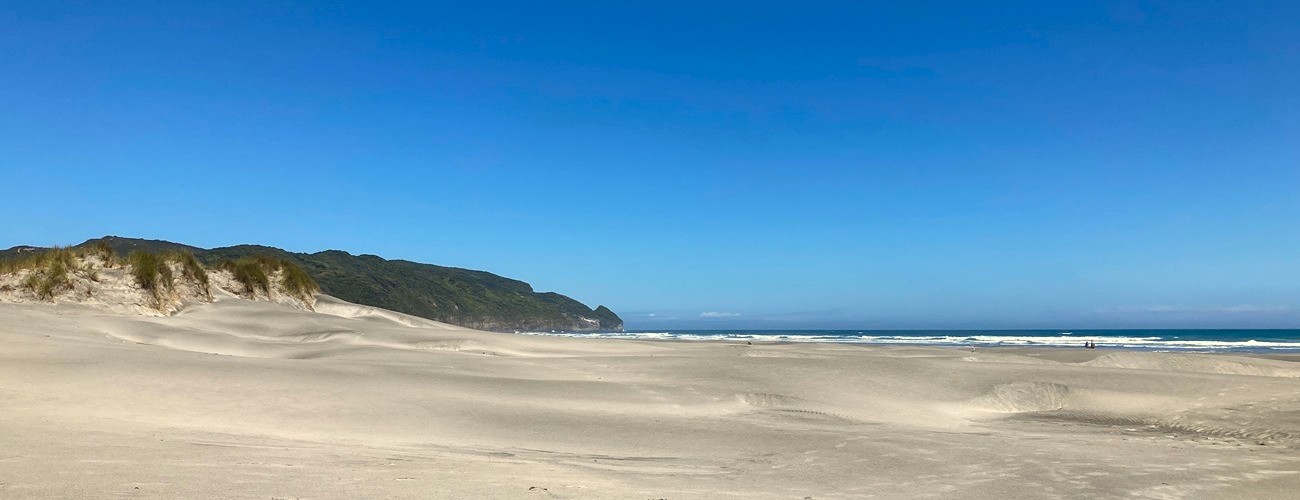
Farewell Spit Walk is a loop route at the base of Farewell Spit, New Zealand’s longest sandspit and an area of great ecological significance. The geography of Farewell Spit reflects the balance between sand supply, wind, waves, and tidal processes, creating a constantly evolving landscape that feels both remote and expansive.
| Details | |
| Length | 11.5 km (full loop) or 5.4 km (short loop) |
| Time Required | 3-4 hr (full loop) or 1.5 hr (short loop) |
| Trail Type | Walking track/Route |
| Physical Difficulty | Moderate |
| Uses | Walking and trail running |
| Direction | Either |
Fossil Point Track
Walking and trail running
Puponga Hilltop Track
Walking and trail running
45 min from Tākaka
From Collingwood, continue north on Collingwood–Puponga Main Road to Puponga. At Puponga, follow the road as it makes a left-hand turn, then turn right onto Freeman Access Road (signposted for Farewell Spit). Follow the gravel road to the Triangle Flat car park, which is the main start point for the walk.
This is a loop walk that can be completed in either direction from Triangle Flat car park.
Heading in an anti-clockwise direction from the car park, the route heads along Inner Beach on the sheltered Golden Bay side of the spit. There’s no marked track; it’s a case of picking the easiest path along the firmer sand at the tide’s edge. After 1.4 km a 4WD track cuts left across the spit, leading to the Tasman Sea side through old dune systems and established kānuka – take this track if you want a shorter loop.
For the full loop, continue along Inner Beach for a further 2.6 km. Turn left to head inland over the marked track that leads to Ocean Beach on the outer Tasman Sea side of the spit. Public access further along the spit beyond here is prohibited due to the ecological sensitivity.
Once on Ocean Beach, head left and follow the beach west to Fossil Point (there’s no marked track). You can turn left and head back to the car park via the aforementioned 4WD track, or continue on to Fossil Point and return via Fossil Point Track (see map for track layout).
Fossil Point Track is another option as an easy out-and-back walk (5 km) from Triangle Flat car park. The track leads to Fossil Point, where at low tide fossilised shells can be seen in the mudstone rocks that have fallen off the cliff above. You may also see seals here.
Formation of Farewell Spit
Farewell Spit is the longest sandspit in New Zealand, stretching for about 25 km from Cape Farewell, with additional shifting sand banks extending even further offshore. Though the spit appears as a narrow landform on maps, low tide exposes around 80 km² of intertidal sand and mud flats on the sheltered Golden Bay side.
The spit has formed over thousands of years as sediment eroded off the Southern Alps has been carried north along the West Coast by ocean currents and prevailing westerly winds. These deposits accumulate at Cape Farewell, where the coastline swings sharply east, allowing the sand to build outward into the bay. The process is ongoing: on the Tasman Sea (northern) side the dunes are younger and constantly reshaped, driven by strong westerlies and continuing sand supply. Here, the wind creates crescent-shaped barchan dunes with a gentle windward slope and a steeper leeward face, slowly migrating eastward over time.
The Golden Bay side is more sheltered and stable, with older dune systems, patches of vegetation, and shallow lakes and wetlands. At low tide, the intertidal flats extend up to seven kilometres offshore. These wide, shallow areas are of international importance for migratory birds, but they also contribute to frequent whale strandings, particularly of pilot whales, which may become trapped as the tide falls.
The spit is known to Māori as Onetahua, meaning ‘accumulated sand’. The first recorded European sighting was by Abel Tasman in 1642, who sketched and named the feature Sand Duining Hoeck. In 1770, James Cook charted the area and named the nearby headland Cape Farewell, as it was the last part of New Zealand his expedition saw before sailing for Australia. Early European settlers referred to the sandbanks as Cape Farewell Spit, later shortened to Farewell Spit.


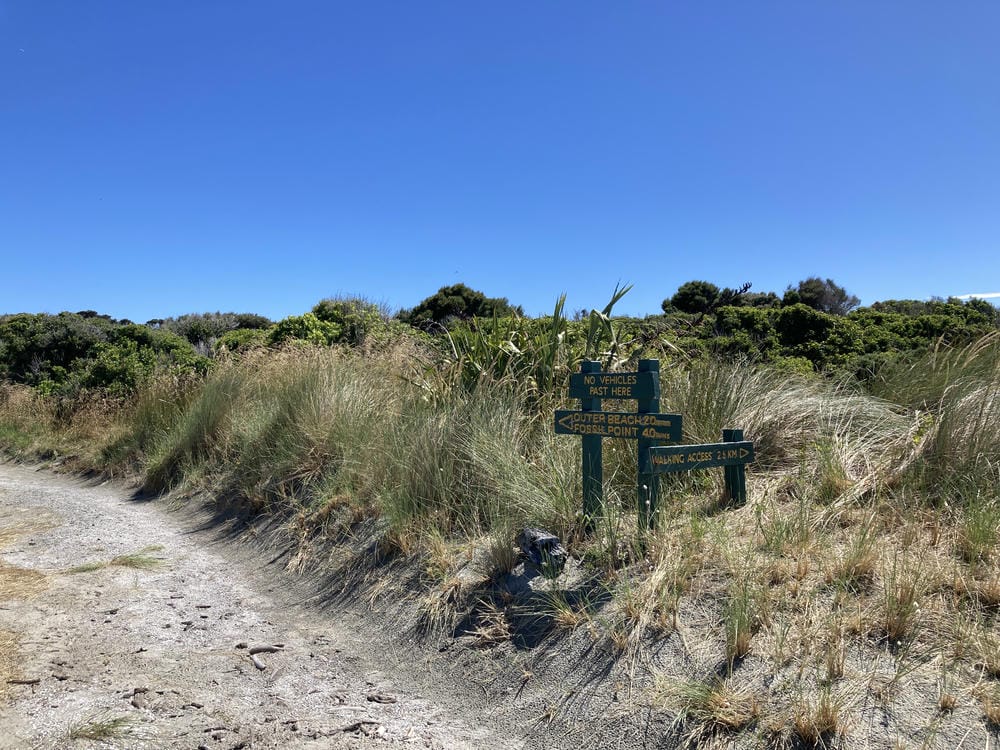


This walk is very exposed, with little to no shade and often windy conditions. There are no water sources along the way, so make sure to carry plenty of your own. Ocean Beach is generally unsafe for swimming. Make sure to keep your distance from any seals you encounter.
Fossil Point Track
Walking and trail running
Puponga Hilltop Track
Walking and trail running