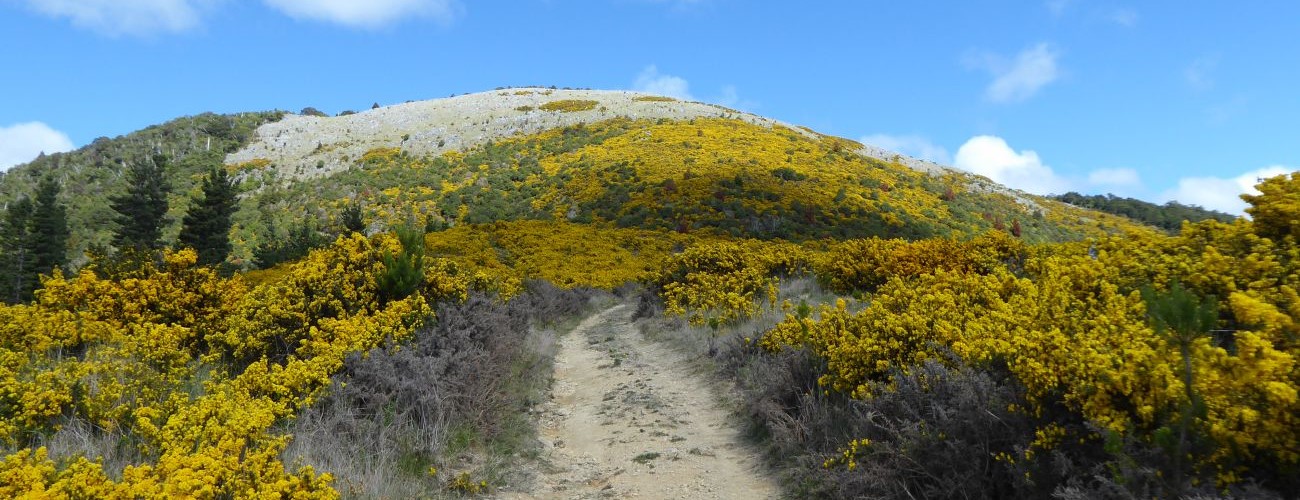
Mt Malita
Roding Water Reserve
Mt Malita (959 m) is located near the head of the Aniseed Valley. Forestry road access to within a short distance of the summit allows it to be climbed by foot or bike. The summit provides great views across Tasman Bay.
| Details | |
| Length | 10.6 km return |
| Time Required | 4-5 hr return (walking) |
| Trail Type | Forestry road |
| Physical Difficulty | Hard |
| Uses | Walking, trail running and MTB |
| Start Elevation | 180 m |
| Max Elevation | 959 m |
Mt Malita Road does not connect to any other official tracks. Experienced parties may continue along the ridge from the summit to Mt Meares and further to Te Araroa Trail (south of Rocks Hut).
40 min from Nelson
Head south from Richmond along State Highway 6 and turn left onto Aniseed Valley Rd at Hope. Go over Aniseed Hill, and continue the entire way up Aniseed Valley Rd (unsealed after the turnoff to Hacket Track) until you reach the Roding car park. This is also the starting point for Champion Mine Circuit.
The access route to the summit of Mt Malita is entirely within Roding Water Reserve, which is managed by Nelson City Council.

Cross the bridge over the Roding River and head right on Summit Rd. After 1.2 km Old Malita Rd forks off to the right. Continue on Summit Rd as it climbs through pine forest, first planted in the late 1940s, for 2.5 km to 575 m elevation, at which point it reconnects with Old Malita Rd. Summit Rd continues to a skid site at 725 m elevation, where the road splits three ways; Burridge Rd heads left, Spar Rd heads right, but to get to the summit, head up the middle road, which climbs straight up the spur. The road dips briefly into a low saddle that marks the end of the forestry block, and then climbs again through regenerating native bush.
The 4WD road ends and a walking track climbs steeply up the bank on the left, heading straight up the grassy hillside, which is scattered with limestone outcrops and long-dead tree trunks and stumps. The summit is fringed by beech forest and is marked by a survey pipe set into a limestone outcrop. Tucked beside the forest is a two-bunk Nelson City Council hut, which is usually locked. The boundary of Mount Richmond Forest Park roughly follows the forest edge.
Just below the summit is a small concrete platform built in 1962 to support a telescope housed within a shelter. Researchers from the University of Pennsylvania used the site to investigate the suitability of Mt Malita for an astronomical observatory. Mt John near Lake Tekapo was ultimately chosen as the observatory site.
Return the way you came.
The origin of the name Malita remains uncertain. The name appears on topographic maps by 1918, although is mapped in James Bell’s 1911 The Geology of the Dun Mountain Subdivision, Nelson as Mount Malanta. Whether Malita is a variation of this earlier name, a cartographic error, or a deliberate renaming has not yet been established.


Sources and further reading
1. Bateson, F.M. (1964). Final Report on the Site Selection Survey of New Zealand. Publications of the University of Pennsylvania, Astronomy Series X.
Mt Malita Road does not connect to any other official tracks. Experienced parties may continue along the ridge from the summit to Mt Meares and further to Te Araroa Trail (south of Rocks Hut).