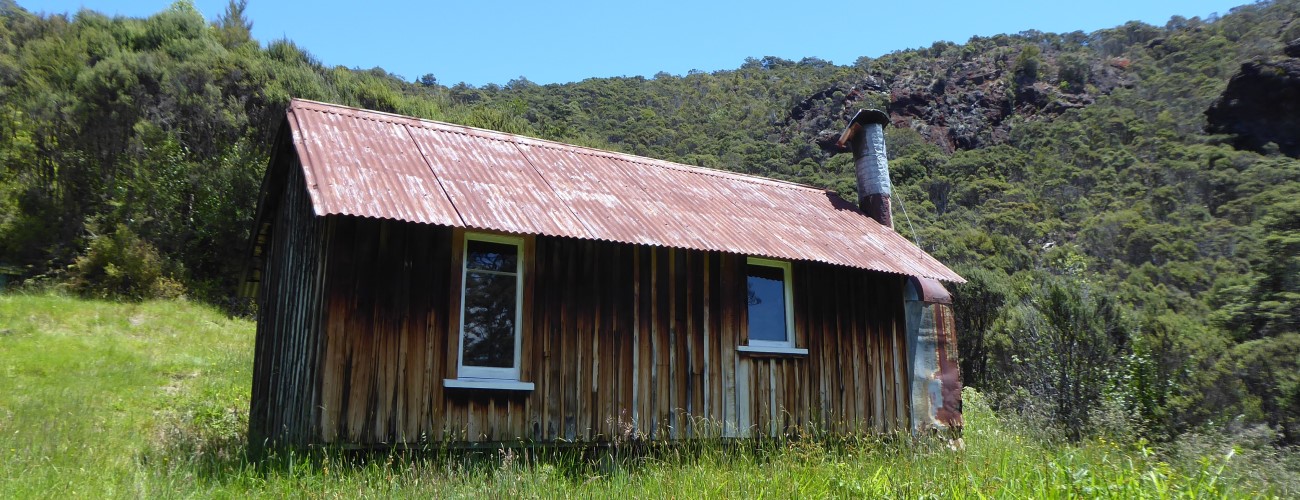
Asbestos Cottage
Kahurangi National Park
Asbestos Cottage is a historic hut in the Upper Tākaka Valley, in Kahurangi National Park. The hut was originally built in 1897 for the purpose of prospecting the nearby asbestos deposits, but is best known for being occupied for nearly four decades from 1914 by Henry and Annie Chaffey.
| Details | |
| Length | 5 km Cobb Ridge to Asbestos Cottage; 13.3 km Asbestos Cottage to Flora car park |
| Time Required | 1 hr 45 min Cobb Ridge to Asbestos Cottage; 3-5 hr Asbestos Cottage to Flora car park |
| Trail Type | Tramping track |
| Physical Difficulty | Moderate |
| Uses | Walking and trail running |
| Max Elevation | 1154 m |
Bullock Track
Walking and trail running
Flora Track (at Upper Junction)
Walking and trail running
Upper Tākaka Track (at Lower Junction)
Walking, trail running and MTB
2 hr from Nelson | 1 hr from Tākaka
From Richmond, head west along State Highway 60. After you’ve driven over Tākaka Hill, turn left at Upper Tākaka onto Cobb Dam Rd, and follow it up Cobb Valley. The road is narrow with steep drop-offs to the Tākaka River below, and is unsealed from the powerhouse. Continue up the road to the summit of Cobb Ridge, where Cobb Ridge Track starts adjacent to the information kiosk.
The former Asbestos Track began on the first hairpin turn on Cobb Dam Rd, a few kilometres up-valley of the powerhouse. DOC has closed this track due to potential health risks from the nearby asbestos mine.
Cobb Ridge Track heads along the broad Cobb Ridge, passing through patchy mānuka interspersed with sections of beech forest, with great views of the Cobb Reservoir and Iron Hill. The track undulates along the ridge before climbing to Pt 1154, where you’ll reach the turnoff to Asbestos Cottage Track. Turn left here and follow the track as it descends the ridge along a broad spur through beech forest. As you near the hut the track veers off to the left and the vegetation transitions to mānuka scrub.
Asbestos Cottage stands in a grassy clearing on the hillside, looking northeast down Upper Tākaka Valley. It has been largely preserved from its original state; its interior is quite dark due to the low ceiling and small windows, and the heating source is an open fireplace. Bunks are located in the small room at the back.
| Asbestos Cottage | |||
| Hut Type | Basic Hut | Capacity | 4 |
| Bookings | Not required; first in, first served | Elevation | 840 m |
The cottage sits on the edge of the Cambrian-aged Cobb Igneous Complex, an unusual body of mafic and ultramafic rocks emplaced over 500 million years ago. Among these rocks is dunite, an olivine-rich rock formed deep within the Earth’s upper mantle. Over time, groundwater altered parts of the dunite to serpentinite, producing veins of chrysotile (white asbestos). These naturally occurring asbestos deposits were mined intermittently from their discovery in the 1880s until the mine closed in 1963. The stunted vegetation surrounding the cottage is another consequence of the ultramafic geology, with only specially adapted plants able to tolerate the infertile, magnesium-rich soils. Because naturally occurring asbestos remains in the area, DOC has permanently closed the original access track and now routes visitors to the cottage via Cobb Ridge Track.
Beyond Asbestos Cottage
Beyond the cottage, Lower Junction Track continues up the Tākaka River Valley to Lower Junction (1 hr). Here you’ll connect with Bullock Track and a swing bridge across Tākaka River, where Upper Tākaka Track branches to the left soon after. From here it’s 2.3 km to Upper Junction, where you’ll connect with Flora Track. The route from Asbestos Cottage to Flora car park via Upper Tākaka Track is 13.3 km in total.


Sources and further reading
1. Blair, A. K. (1994). The Cobb: The History of Cobb River Hydro-Electric Power Scheme.
2. Henderson, J. (1981). The Exiles of Asbestos Cottage.
3. Judd, W. (1991). The Chaffeys of Asbestos Cottage. New Zealand Geographic.