Champion Mine Circuit
Roding Water Reserve
Champion Mine Circuit takes in the historic Champion Smelter, and Champion and United copper mines. The circuit provides insight to the history of Nelson’s short-lived copper industry that began in the late 1800s, and traverses the fascinating Dun Mountain Mineral Belt. The full circuit may take half a day to complete, though the smelter can be visited as a shorter out-and-back walk.
| Details | |
| Length | 13.3 km (full circuit); 8 km return to smelter |
| Time Required | 4-5 hr (full circuit); 3 hr return to smelter |
| Trail Type | 4WD road/Tramping track/Route |
| Physical Difficulty | Hard (full circuit) |
| Uses | Walking and trail running (MTB access to 4WD road end below United Mine) |
| Direction | Clockwise circuit direction recommended (United Mine to Champion Mine) |
| Start Elevation | 180 m |
| Max Elevation | 739 m |
| Dog Access | Dogs are prohibited in Roding Water Reserve |
This circuit does not connect to any other official tracks. Experienced parties may climb Jenkins Hill via the historic Roding Ridge route, or continue onward from United Mine, to Monster Mine and Te Araroa Trail near Rocks Hut. The open country of the mineral belt allows relatively straightforward off-route travel for those with appropriate navigation skills.
40 min from Nelson
Head south from Richmond along State Highway 6 and turn left onto Aniseed Valley Rd at Hope. Go over Aniseed Hill, and continue the entire way up Aniseed Valley Rd (15 km), until you reach the Roding car park. After the Hacket car park turnoff the last 7 km are unsealed. Roding car park is also the start point for trips up Mt Malita.


Head past the caretaker’s house up the 4WD road that climbs above the true left of the Roding River. Roding Dam is a short deviation off the left and is worthy of a look. The road descends and crosses Roding River, at which point it enters native forest. Soon you will see a sign indicating the turnoff to a shortcut track that cuts straight up the hill on the opposite side of the river to meet the tram alignment en route to Champion Mine. Continue along the road and cross Roding River next to where it forks with United Creek. Champion Smelter is a few hundred metres further along.
The remains of Champion Smelter are located on a grassy clearing at a bend on United Creek. An information panel describes the history of the mining operations, and photos provide an interesting perspective of what the site used to look like.
Continue along the road for a further 1.8 km until it ends at United Creek at the beginning of the mineral belt. Cross the creek and follow the track as it winds up a rocky gully through scrubby native bush to United Mine. The first evidence of mining operations is rusty artifacts that are scattered among the rocks and scrub. The gully opens up at the area of workings; at this point the track becomes a bit vague and quite difficult. Orange and white markers indicate the general direction, though the steep, loose ore deposits and boulders can be dangerous to traverse, especially as there is a risk of dislodging rocks onto anyone following behind you. This section of the circuit is easier to climb than descend, and for this reason a clockwise circuit direction is recommended. There are several shafts driven into the hillside at varying levels up the gully. Beyond the signposted No.2 Level Shaft, the track climbs steeply out of the left side of the gully.
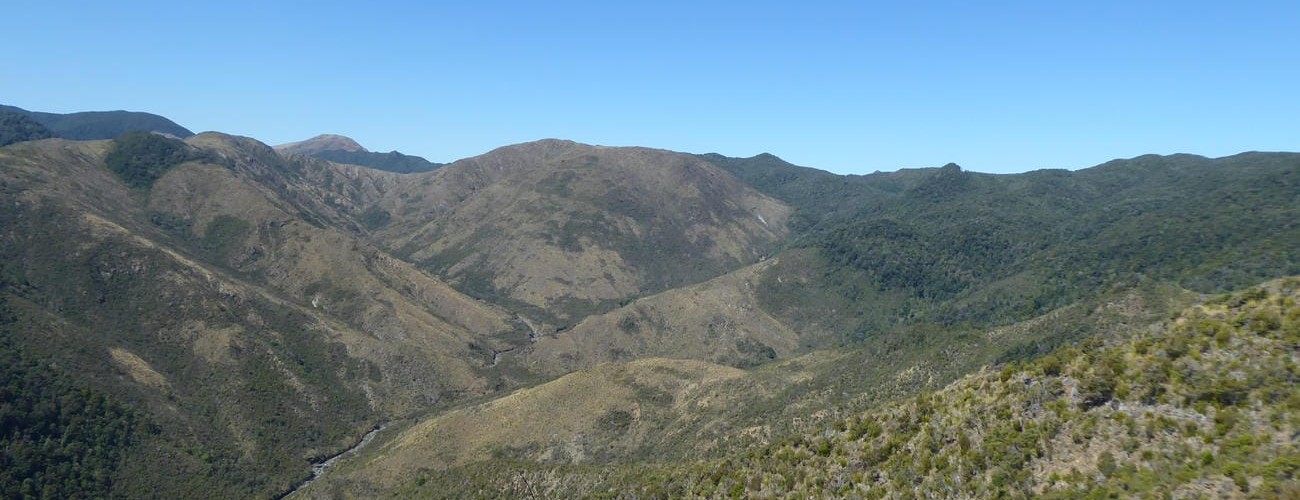
Once out of the gully and onto a spur, the track is well-defined and climbs steeply through the mineral belt to the top of the ridge that delineates the United Creek and Champion Creek catchments. A rocky knob marks the 739 m high point of the circuit. Here you will enjoy stunning views of the mineral belt. The track drops along the ridge and enters beech forest, zig-zagging down toward Champion Mine.
At the valley floor you will reach the junction with the tramway; turn left and you will immediately reach Champion Mine. The first thing you will see is the 46 m deep North Shaft. The shaft has been flooded since its abandonment a century ago, so it does not pose a significant danger. Across Champion Creek the tell-tale spoil piles indicate the location of Doctor’s Lode, the most profitable lode in the mined area. The South Shaft is on the true left of the creek and slightly further upstream; this shaft is dangerous as it is much wider than the North Shaft and is not flooded. Ore spoil piles drop steeply into the bed of Champion Creek, making it difficult to cross. Pieces of wood and some rusty relics lie scattered among the rocks and scrub.
The track back to the smelter follows the old tramway alignment, which means the gradient is gentle. In the century since its use, sections have slumped and vegetation has encroached, but the Roding caretaker does a good job to keep the track clear. You can turn left onto the aforementioned shortcut track that drops steeply down to the 4WD road, and head back to the car park. Otherwise continue along to the smelter and return along the 4WD road to the car park.
Prospectors first discovered copper and chromite within the distinctive rocks of the Dun Mountain Mineral Belt in the 1850s. In 1859, Austrian geologist Ferdinand von Hochstetter investigated the area and provided the first authoritative scientific description of the mineral belt, helping establish its reputation as one of New Zealand’s most promising mining districts. During the following decades, geologists including Julius von Haast, James Hector and E.H. Davis continued to map and assess the belt’s mineral potential, encouraging further exploration.
In 1881 local prospector Fred Stratford discovered native copper in the upper Aniseed Valley, extending known mineralisation into what became the Champion and United mining district. Prospectors quickly established claims, leading to the development of the Champion, Doctor’s and United lodes. As investment money flowed in, shafts were sunk, tramways were constructed and a smelter was built beside United Creek to process ore on site. Champion Mine became the centrepiece of the operation, with a 46 m shaft completed in 1884 and further development following soon after.
Unlike the large, continuous ore bodies miners had hoped to find, the copper occurred in small and irregular lenses within the serpentinite rocks of the mineral belt. Rich pockets of ore would often disappear within a few metres, making mining difficult and expensive. Early workings at Champion Mine nevertheless produced impressive quantities of native copper, including masses weighing more than 50 kg, along with colourful secondary minerals such as malachite, cuprite and chrysocolla. Government geologist James Mackintosh Bell’s 1911 geological survey noted that the Champion ore bodies were particularly unusual because native copper persisted far deeper underground than at most other Nelson copper prospects.
Investor optimism was high and substantial sums were spent on infrastructure, but the reality failed to match expectations. When the smelter finally entered production in 1886 it operated for only eight days before low copper prices, insufficient capital and disappointing ore reserves brought operations to a halt. Bush fires later damaged sections of the smelter and tramway network, further increasing losses.
Mining activity resumed in 1903 under the Maoriland Copper Company, which reopened and re-timbered underground workings, repaired tramways, dewatered shafts and installed new winding equipment. Bell surveyed the mines during this period and recorded extensive workings at both Champion and United Mines, but remained cautious about their long-term prospects due to the erratic nature of the ore bodies. By 1909 mining had effectively ceased once again, ending nearly three decades of intermittent exploration and investment.
Today the flooded North Shaft, dangerous South Shaft, spoil heaps, tramway formations, smelter ruins and scattered mining relics provide a glimpse into Nelson’s short-lived copper boom.


The mining areas contain abandoned shafts, none of which are fenced off and some are hidden by scrub. Spoil piles are difficult and dangerous to traverse, as the rock is loose and there is no vegetation to hold on to. The circuit has several river and stream crossings, so it cannot be done when flows are high.
Sources and further reading
1. Bell, J. Mackintosh (1911). The Geology of the Dun Mountain Subdivision.
2. Johnston, M. (1987). High Hopes: The History of the Nelson Mineral Belt and New Zealand’s First Railway.
3. Johnston, M. (2011). Roding River (“Nelson Mineral Belt”) Copper Mineralisation and Dun Mountain-Maitai Terrane Stratigraphy.
4. The Prow. Aniseed Valley Copper.
This circuit does not connect to any other official tracks. Experienced parties may climb Jenkins Hill via the historic Roding Ridge route, or continue onward from United Mine, to Monster Mine and Te Araroa Trail near Rocks Hut. The open country of the mineral belt allows relatively straightforward off-route travel for those with appropriate navigation skills.